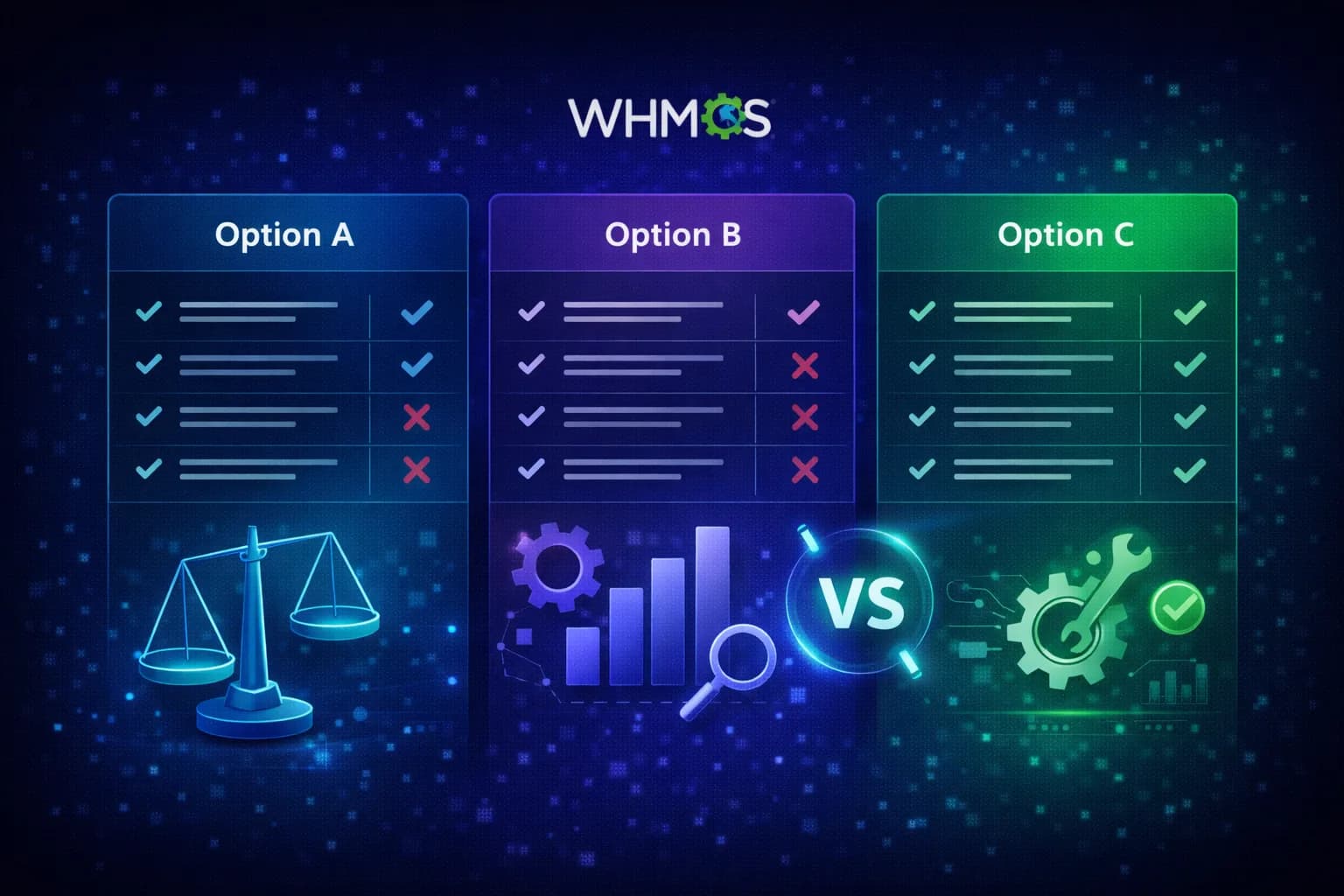
Best AI Gateway for WHMCS: 6 Options Tested and Compared (2026)
We tested OpenRouter, LiteLLM, Portkey, Bifrost, Kong, and Cloudflare AI Gateway with WHMCS. Which one supports MCP, self-hosting, and keeps your billing data private?
MX Modules Team
(Updated )

In this article
AI gateways sit between your applications and LLM providers. They route requests, handle failover, manage API keys, and provide a unified API. For hosting providers using MCP Server for WHMCS, the gateway determines which models process your billing queries and how your data flows.
Six gateways currently support MCP in some form. This comparison evaluates them against hosting-provider criteria: MCP support quality, self-hosting capability, model coverage, data control, and total cost.
Quick Comparison Table
The best AI gateway for WHMCS depends on your priorities. LiteLLM is the top choice for self-hosted deployments with native MCP support and zero licensing cost. OpenRouter is the simplest cloud option with 500+ models. Portkey leads for enterprise governance. The table below compares all six gateways across the criteria that matter most to hosting providers.
| Gateway | MCP Support | Self-Hosted | Models | Pricing | Best For |
|---|---|---|---|---|---|
| OpenRouter | Via MCP servers | No | 500+ | 5.5% fee | Simplicity, model variety |
| LiteLLM | Native MCP Gateway | Yes (Docker/K8s) | 100+ | Free (OSS) | Privacy, total control |
| Portkey | Native MCP Gateway | Yes | 1,600+ | Enterprise | Governance, large teams |
| Bifrost | Native MCP Gateway | Yes | 12+ providers | OSS + Enterprise | Performance, low latency |
| Kong AI Gateway | AI MCP Proxy plugin (v3.12+) | Yes | Multi-provider | Enterprise | Existing Kong users |
| Helicone | No (logging only) | Yes | 100+ | $20/seat/month | Observability, cost tracking |
The most important column for WHMCS providers is "MCP Support." Only four gateways have native MCP integration. Helicone is observability-focused and does not route MCP tool calls.
OpenRouter
OpenRouter is the best AI gateway for WHMCS hosting providers who want a managed, zero-infrastructure solution. It offers 500+ models from 30+ providers through a single API key, with automatic failover and intelligent routing that can reduce AI costs by 40-85%.
OpenRouter is a cloud-hosted API gateway with 500+ models from 30+ providers. It is the simplest option: sign up, get an API key, start routing.
MCP support: OpenRouter works with MCP through community MCP servers. Multiple implementations exist (physics91/openrouter-mcp, heltonteixeira/openrouterai, stabgan/openrouter-mcp-multimodal). Composio offers an OpenRouter MCP + Claude Code integration. The support is functional but not built into the gateway itself.
WHMCS relevance:
- 24+ free models for basic WHMCS queries (client lookups, service status)
- Automatic failover if a provider goes down
- Single consolidated invoice for all model usage
- Intelligent routing reduces costs 40-85% vs single model setups
- No infrastructure to manage
Limitations:
- Cloud-only. WHMCS data passes through OpenRouter servers.
- 5.5% fee on all credit purchases
- ~25ms additional latency per request
- No per-key MCP permissions
- No self-hosting option
Cost example (300 clients, 3,000 queries/month):
- MCP Server: $22/month
- Model costs via OpenRouter: ~$7-15/month (routed)
- OpenRouter fee: included in credit purchase
- Total: ~$29-37/month
Best for: Hosting providers who want the simplest setup with access to many models. Full OpenRouter guide.
LiteLLM
LiteLLM is the best AI gateway for WHMCS providers who need full data control and self-hosting. It is open source, has native MCP Gateway support since version 1.80.18, and costs nothing to license. Your WHMCS billing data never leaves your infrastructure.
LiteLLM is an open-source proxy server you host yourself. Since version 1.80.18, it has a native MCP Gateway that makes WHMCS tools available to every connected model.
MCP support: Native. The MCP Gateway is built into the proxy. Configure MCP Server once, and every model routed through LiteLLM gets access to WHMCS tools. Per-key and per-team MCP permissions control who accesses what.
WHMCS relevance:
- Self-hosted: WHMCS data stays on your infrastructure
- Native MCP Gateway with per-team permissions
- Works with local models (Ollama, vLLM) for zero per-query cost
- Full audit trail under your control
- GDPR-friendly data residency
Limitations:
- Self-managed infrastructure (Docker, updates, monitoring)
- MCP Gateway is relatively new (v1.80.18+, still maturing)
- Smaller model catalog than OpenRouter (you configure what you need)
- Requires technical expertise to deploy and maintain
Cost example (300 clients, 3,000 queries/month):
- MCP Server: $22/month
- LiteLLM: $0 (open source)
- Local model (Ollama on existing server): $0
- Total: $22/month (on existing hardware)
Best for: Hosting providers with data residency requirements or existing server infrastructure. Full LiteLLM guide.
Portkey
Portkey is the best AI gateway for large WHMCS hosting operations that require enterprise governance, guardrails, and compliance controls. It offers the largest model catalog at 1,600+ integrations and native MCP Gateway support with per-team access scoping.
Portkey is an enterprise AI gateway with 1,600+ model integrations. It provides governance features like guardrails, caching, load balancing, and access control.
MCP support: Native MCP Gateway. Portkey can act as a bridge between MCP clients and MCP servers, adding governance and observability to tool calls.
WHMCS relevance:
- Largest model catalog (1,600+)
- Enterprise-grade access control and guardrails
- Request caching reduces costs and latency
- Semantic caching (similar queries return cached results)
- Self-hosted or cloud deployment
Limitations:
- Enterprise pricing (not published, contact sales)
- Overkill for small hosting operations
- More complex setup than OpenRouter or LiteLLM
- Designed for large teams, not solo operators
Cost example:
- MCP Server: $22/month
- Portkey: Enterprise pricing (estimated $200+/month for small teams)
- Model costs: varies
- Total: $222+/month
Best for: Large hosting companies with 10+ team members accessing WHMCS data through AI, or companies requiring enterprise governance and compliance.
Bifrost
Bifrost is the best AI gateway for WHMCS deployments where response latency is the top priority. It delivers sub-millisecond routing overhead, which is the lowest of any gateway in this comparison. Bifrost supports 12+ LLM providers and includes native MCP Gateway support.
Bifrost is a high-performance AI gateway focused on speed. It supports 12+ LLM providers with sub-millisecond routing overhead and native MCP Gateway support. For WHMCS hosting providers, latency matters when support staff or AI agents need instant answers about client accounts, billing status, or service configurations. A slow gateway adds noticeable delay to every tool call.
MCP support: Native MCP Gateway. Bifrost routes MCP tool calls with the same low-latency approach it uses for model requests. This means WHMCS tools like client lookups and invoice queries execute with minimal gateway-added delay, keeping the interactive experience fast for support teams.
WHMCS relevance:
- Lowest latency overhead of any gateway
- Native MCP support
- Open source core with enterprise features
- Self-hosted deployment
- Well-suited for high-volume WHMCS operations where hundreds of queries per minute flow through the gateway
Limitations:
- Smaller provider coverage (12+ vs 500+ for OpenRouter)
- Newer project, smaller community
- Enterprise features require paid license
- Less documentation for MCP-specific use cases
- No built-in per-team permissions for MCP tool access
Best for: Performance-critical deployments where every millisecond matters, or hosting providers already using Bifrost for other workloads. If your support team processes high volumes of AI-assisted tickets, Bifrost ensures the gateway layer does not become a bottleneck.
Kong AI Gateway
Kong AI Gateway is the best option for WHMCS hosting providers who already run Kong for API management. Instead of deploying a separate AI gateway, you add the AI MCP Proxy plugin to your existing Kong installation. This reuses your existing rate limiting, authentication, and logging configuration.
Kong is a widely-used API gateway that added AI capabilities in version 3.12+, including an AI MCP Proxy plugin.
MCP support: AI MCP Proxy plugin. Kong acts as a proxy between MCP clients and MCP servers, adding Kong's existing API management features (rate limiting, authentication, logging) to MCP traffic.
WHMCS relevance:
- If you already use Kong for API management, adding WHMCS MCP is easy
- Enterprise-grade rate limiting and authentication
- Existing Kong plugins work with MCP traffic
- Self-hosted or cloud (Konnect)
Limitations:
- Kong is an API gateway first, AI gateway second
- MCP support is via plugin, not native architecture
- Complex setup if you are not already a Kong user
- Enterprise pricing for full features
Best for: Hosting companies already using Kong for API management who want to add WHMCS MCP routing to their existing infrastructure.
Helicone (Observability Only)
Helicone is not an AI gateway for routing or MCP. It is an observability platform that logs, monitors, and analyzes AI requests. It appears in gateway comparisons frequently, so it is included here to clarify its actual role. Helicone does not replace any of the gateways above.
Helicone is included in this comparison because hosting providers researching AI gateways often encounter it in search results and feature lists. The distinction matters. A routing gateway like OpenRouter or LiteLLM decides which model handles your request and manages MCP tool calls. Helicone does neither of those things. It sits as a transparent logging layer that records every AI request and response, giving you dashboards for cost tracking, latency monitoring, and usage analytics.
MCP support: None. Helicone logs requests but does not act as an MCP gateway or proxy. It cannot discover or execute WHMCS MCP tools.
WHMCS relevance:
- Useful for monitoring AI costs and usage patterns across all WHMCS queries
- Can sit alongside any other gateway as a logging layer (pair it with LiteLLM or OpenRouter)
- Helps identify which WHMCS operations consume the most AI tokens
- $20/seat/month for the paid tier
Not useful for: Routing models or managing MCP connections. If you need to route WHMCS queries to different models or manage MCP tool access, choose one of the five gateways above and optionally add Helicone for visibility.
Decision Framework for Hosting Providers
Choosing an AI gateway for WHMCS comes down to three factors: your company size, your top priority (cost, privacy, or simplicity), and your team's technical capability. The tables below map each factor to a specific gateway recommendation so you can make a decision in minutes, not hours.
Most hosting providers fall into one of two camps. Providers who want zero infrastructure management should use OpenRouter. Providers who need data privacy or want to eliminate per-query costs should self-host LiteLLM. The remaining gateways serve specialized needs: Portkey for enterprise compliance, Bifrost for latency-sensitive operations, and Kong for teams already running Kong infrastructure.
By Company Size
Your client count determines query volume, which directly affects cost and infrastructure needs. Solo operators rarely need a gateway at all. The breakpoint where a gateway starts paying for itself is around 100 clients, where query volume creates enough traffic to benefit from model routing and cost optimization.
| Company Size | Recommended Gateway | Reason |
|---|---|---|
| Solo operator (< 100 clients) | Direct API (no gateway) | Simplest setup, low query volume |
| Small team (100-500 clients) | OpenRouter | Easy setup, model variety, managed |
| Medium team (500-2,000 clients) | LiteLLM | Cost control, privacy, per-team permissions |
| Large operation (2,000+ clients) | Portkey or LiteLLM | Enterprise governance, compliance |
The key takeaway is that small teams benefit most from managed solutions like OpenRouter, while medium and large operations save enough on per-query costs to justify self-hosting LiteLLM. Enterprise governance features from Portkey only make financial sense at 2,000+ clients.
By Priority
Every hosting provider has a different top concern when choosing an AI gateway. Some prioritize keeping WHMCS billing data on their own servers. Others care most about reducing monthly AI costs. The table below maps each priority to the gateway that best addresses it.
| Priority | Best Choice | Why |
|---|---|---|
| Simplicity | OpenRouter | One API key, managed infrastructure |
| Cost control | LiteLLM + local models | Zero per-query cost |
| Data privacy | LiteLLM (self-hosted) | WHMCS data stays on your server |
| Model variety | OpenRouter (500+) or Portkey (1,600+) | Largest catalogs |
| Performance | Bifrost | Sub-millisecond routing overhead |
| Existing infrastructure | Kong (if using Kong) | Use existing setup |
| Enterprise compliance | Portkey | Guardrails, governance, audit |
Data privacy and cost control both point to LiteLLM because self-hosting eliminates both the risk of sensitive billing data leaving your infrastructure and the per-query fees charged by cloud gateways. If neither privacy nor cost is your primary concern, OpenRouter provides the fastest path to production.
By Technical Skill
Technical capability is a practical constraint that narrows the field. Self-hosted gateways like LiteLLM and Bifrost require Docker knowledge and ongoing server maintenance. If your team does not have that expertise, OpenRouter removes the infrastructure burden entirely.
| Technical Level | Best Choice | Setup Time |
|---|---|---|
| Non-technical | OpenRouter | 10 minutes |
| Comfortable with Docker | LiteLLM | 30-60 minutes |
| DevOps team available | Portkey or Bifrost | 2-4 hours |
| Already running Kong | Kong AI plugin | 30 minutes |
Setup time matters because it affects time-to-value. OpenRouter gets you routing WHMCS queries through multiple AI models in 10 minutes. LiteLLM takes 30-60 minutes but gives you permanent cost savings and data control. The investment in setup time pays off quickly for providers processing thousands of monthly queries.
MCP Support Depth Comparison
LiteLLM and Portkey provide the deepest MCP integration, with native tool discovery, per-key permissions, per-team scoping, and audit logging built into the gateway. OpenRouter relies on community-maintained MCP servers. Kong extends MCP support through its existing plugin system rather than native architecture.
Not all "MCP support" is equal. A gateway that claims MCP compatibility might only pass through requests without adding any governance or security controls. For WHMCS hosting providers, the critical MCP features are per-key permissions (controlling which API keys can access which WHMCS tools), per-team scoping (restricting billing data access by department), and audit logging (tracking every tool call for compliance).
| MCP Feature | OpenRouter | LiteLLM | Portkey | Bifrost | Kong |
|---|---|---|---|---|---|
| Tool discovery | Via community servers | Native | Native | Native | Plugin |
| Tool execution | Via community servers | Native | Native | Native | Plugin |
| Per-key permissions | No | Yes | Yes | Varies | Via Kong policies |
| Per-team scoping | No | Yes | Yes | No | Via Kong RBAC |
| Auto-execute tools | Client-dependent | Yes (configurable) | Yes | Yes | Client-dependent |
| Audit logging of tool calls | No | Yes | Yes | Yes | Via Kong logging |
| Caching of tool results | No | No | Yes (semantic) | No | Via Kong caching |
LiteLLM and Portkey have the deepest MCP integration with full governance controls. OpenRouter relies on community implementations, which means MCP support depends on third-party maintainers rather than the gateway vendor. Kong uses its existing plugin architecture, which provides equivalent functionality through a different mechanism but requires familiarity with Kong's configuration model.
Cost Comparison Summary
The cheapest AI gateway setup for WHMCS is LiteLLM with local models at $22/month total (only the MCP Server license). The cheapest cloud option is OpenRouter at $33/month. Portkey starts at $232+/month, making it viable only for large operations where governance features justify the premium.
For a hosting provider with 300 clients, 3,000 queries/month, using a mix of free and paid models, the total monthly cost varies dramatically depending on the gateway choice. The table below breaks down each cost component: the gateway license, the AI model usage, and the MCP Server for WHMCS subscription.
| Gateway | Gateway Cost | Model Cost | MCP Server | Total Monthly |
|---|---|---|---|---|
| No gateway (direct Claude) | $0 | ~$18 | $22 | $40 |
| OpenRouter | ~$1 (5.5% fee) | ~$10 | $22 | $33 |
| LiteLLM (local models) | $0 | $0 | $22 | $22 |
| LiteLLM (cloud models) | $0 | ~$10 | $22 | $32 |
| Portkey | $200+ | ~$10 | $22 | $232+ |
LiteLLM with local models is the cheapest option because both the gateway and model inference cost nothing. You run open-source models like Llama or Mistral on your existing server hardware. OpenRouter is the cheapest among cloud-only options because its 5.5% fee on credit purchases is offset by intelligent routing that selects cheaper models for simple queries. Portkey only makes financial sense at enterprise scale where governance features, compliance requirements, and multi-team access control offset the $200+/month premium.
Frequently Asked Questions
Hosting providers considering AI gateways for WHMCS consistently ask the same questions: whether they need a gateway at all, whether they can switch later, and which gateway has the strongest MCP support. The answers below address each of these based on real deployment scenarios.
Do I need a gateway at all? Not for simple setups. If you use Claude Desktop with MCP Server, a direct connection works fine. Gateways add value when you use multiple models, need cost optimization, or require per-team access control.
Can I switch gateways later? Yes. MCP Server for WHMCS is gateway-independent. It provides the same 46 tools no matter which gateway (or no gateway) sits in front. Switching gateways does not require reconfiguring MCP Server.
Which gateway has the best MCP support? LiteLLM, because the MCP Gateway is native and includes per-key and per-team permissions. Portkey is close second with added governance features.
What about Zapier or Make for WHMCS automation? Zapier and Make are workflow automation tools, not AI gateways. They serve a different purpose. For workflow automation with MCP, see n8n integration.
Summary
For most WHMCS hosting providers, the decision comes down to two gateways: OpenRouter for simplicity and LiteLLM for cost control and data privacy. These two cover 90% of hosting provider use cases. Portkey, Bifrost, and Kong serve specialized needs that only apply to a subset of operations.
The recommended path for a hosting provider getting started with AI is straightforward. Start with MCP Server for WHMCS and a direct API connection to Claude or another model. Once you outgrow a single model, add OpenRouter for instant access to 500+ models with zero infrastructure. When query volume and data sensitivity justify self-hosting, migrate to LiteLLM for full control and zero per-query costs.
All six gateways in this comparison work with MCP Server for WHMCS because MCP Server is gateway-independent. Your WHMCS tools remain the same regardless of which gateway routes the AI traffic. This means you can switch gateways at any time without reconfiguring your WHMCS integration.
Next steps:
- Install MCP Server for WHMCS
- Set up OpenRouter for cloud model routing
- Deploy LiteLLM for self-hosted AI
- Reduce AI costs 60% with model routing
Related
- 5 AI Prompts WHMCS Admins Should Save - Ready-to-paste prompts for daily WHMCS work
- Automate WHMCS Without Code - Turn repetitive admin tasks into one-click AI workflows
- WHMCS 9.0: What Changed for Module Developers and Hosting Providers - Full breakdown of the latest version
- Build a WHMCS Dashboard with AI in 10 Minutes - Combine MCP and Claude for instant insights
MCP Server
AI Integration for WHMCS
Connect AI to your WHMCS. Query clients, invoices, and tickets using natural language. Cancel anytime.
Documentation
Did you find this helpful?
Join other WHMCS professionals and get our latest guides and AI tips directly in your inbox.
MX Modules Team
We run a hosting business on WHMCS. These modules are the tools we built to solve our own problems, and now we share them with other providers.