Onboard New Hosting Clients in WHMCS
Most hosting providers skip onboarding and pay for it with early churn. Follow this step-by-step WHMCS workflow to reduce cancellations and keep clients longer.
MX Modules Team
(Updated )
In this article
- Why Onboarding Matters for Hosting Providers
- The Onboarding Emails
- Email 1: Welcome (Day 0, Automatic)
- Email 2: Quick Start Guide (Day 1)
- Email 3: Migration Offer (Day 3)
- Email 4: Feature Highlight (Day 5)
- Email 5: Check-in (Day 7)
- Setting Up the Sequence in WHMCS
- Option A: Manual Triggers with Email Templates
- Option B: WHMCS Automation Rules (Business Edition)
- Option C: External Email Tool
- Onboarding Checklist Template
- Measuring Onboarding Success
- Common Mistakes
- Sending too many emails
- Making emails too long
- Not segmenting by product
- Skipping the check-in
- Frequently Asked Questions
- Do I need WHMCS Business edition for onboarding automation?
- How do I handle onboarding for reseller clients?
- Should I include upsell offers in onboarding emails?
- What if a client doesn't open any onboarding emails?
- Can I use this workflow for clients who buy through a proposal?
A new client signs up for hosting. WHMCS sends a welcome email with login credentials. The client logs in, sees a control panel they've never used before, and either figures it out alone or opens a support ticket.
That's not onboarding. That's abandonment.
Proper onboarding reduces early churn (first 90 days), cuts support tickets by 30-40%, and increases the chance of upsells. Here's how to build an onboarding workflow inside WHMCS without any custom development.
Why Onboarding Matters for Hosting Providers
Hosting is a low-touch business by design. Clients self-provision, self-manage, and ideally never need to contact you. But the first week is different.
What happens in the first 7 days without onboarding:
| Day | Client experience | Your risk |
|---|---|---|
| Day 0 | Receives welcome email with credentials | Email goes to spam (see SMTP settings) |
| Day 1 | Tries to log in, confused by cPanel/Plesk | Opens first support ticket |
| Day 2 | Can't figure out email setup | Opens second ticket |
| Day 3 | Website migration isn't automatic | "I thought you'd move my site" |
| Day 5 | Considers switching back to old provider | You lose the client |
What happens with onboarding:
| Day | Client experience | Your risk |
|---|---|---|
| Day 0 | Welcome email + "Getting Started" guide | Clear next steps |
| Day 1 | Automatic email: "How to set up your first email account" | Common question pre-answered |
| Day 3 | Automatic email: "Need help migrating your website?" | Offer assistance proactively |
| Day 7 | Check-in: "How's everything going?" | Catch issues before they become complaints |
Same client. Same product. Different experience.
The Onboarding Emails
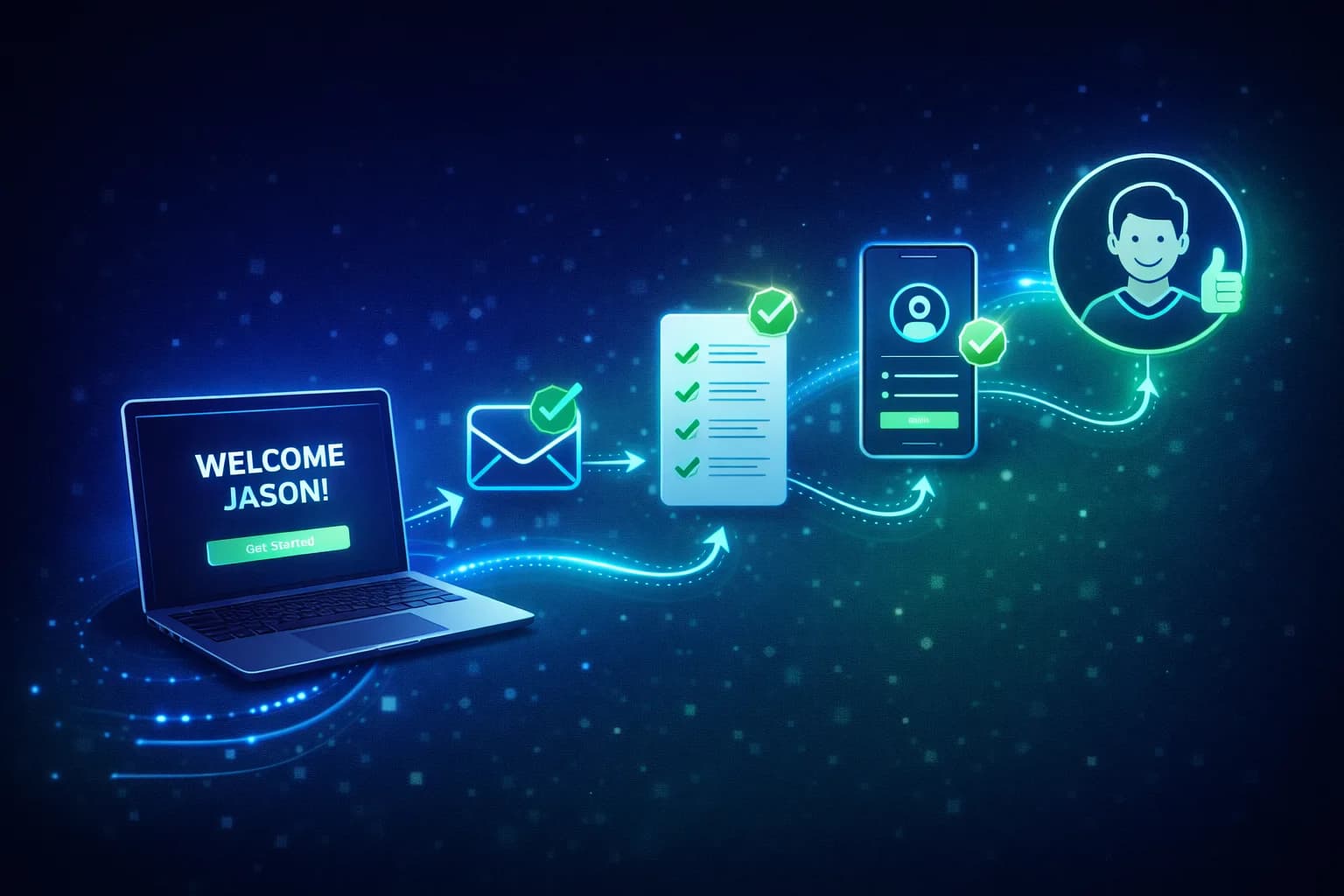
WHMCS has a built-in email template system. You can create custom email templates and trigger them manually or via automation rules. Here's a 5-email onboarding sequence.
Email 1: Welcome (Day 0, Automatic)
WHMCS sends this by default. But the default template is generic. Customize it.
What to include:
- Login URL (client area, not cPanel directly)
- Their plan name and what's included
- Link to your knowledge base or getting started guide
- Your support hours and how to reach you
- One clear next step: "Log in and set up your first email account"
What to remove:
- Server hostname and technical details (they don't need this yet)
- Long legal disclaimers (link to your TOS page instead)
- Everything that isn't actionable in the first 5 minutes
Email 2: Quick Start Guide (Day 1)
Subject: "3 things to set up in your first 24 hours"
Content:
- How to access cPanel/Plesk (with screenshots or video link)
- How to create your first email account
- How to point your domain (or request migration help)
Each item should be 2-3 sentences with a link to a detailed knowledge base article. Don't write a 2,000-word email. Write 3 short paragraphs with links.
Email 3: Migration Offer (Day 3)
Subject: "Need help moving your website?"
Content:
- "If you're migrating from another host, we can help."
- Explain what your migration service includes (free or paid)
- Link to request migration or a migration guide
- If you offer free migrations, say so explicitly
This email prevents the "I thought you'd move my site" misunderstanding. Even if you clearly state migration terms during signup, clients don't read everything. Repeating it on day 3 catches the ones who missed it.
Email 4: Feature Highlight (Day 5)
Subject: "Did you know your plan includes [feature]?"
Content:
- Highlight one feature they probably haven't discovered
- SSL certificates, automated backups, staging environments, email forwarding
- Brief explanation of what it does and why it's useful
- Link to set it up
This email reminds the client they're getting value beyond basic hosting. It reduces the "I'm paying $30/month and all I have is a folder on a server" perception.
Email 5: Check-in (Day 7)
Subject: "How's everything going?"
Content:
- Short, personal tone
- "If you've run into any issues, reply to this email and we'll help."
- Link to your knowledge base
- Optional: link to leave a review (only if they're likely satisfied)
This is the most important email. A client who's been silently frustrated for a week will often respond to a direct check-in. It's your chance to catch problems before the client decides to leave.
Setting Up the Sequence in WHMCS
Option A: Manual Triggers with Email Templates
- Go to Setup > Email Templates
- Create 4 custom templates (emails 2-5, since email 1 is the default welcome)
- Use WHMCS merge fields for personalization:
{$client_name},{$service_product},{$service_domain} - Manually send each email at the right time
Pros: No extra tools needed. Cons: You have to remember to send them. For 5-10 new clients a month, this is manageable. For more, it's not.
Option B: WHMCS Automation Rules (Business Edition)
If you have WHMCS Business edition, you can create automation rules:
| Rule | Trigger | Action |
|---|---|---|
| Day 1 email | 1 day after service activation | Send "Quick Start" template |
| Day 3 email | 3 days after service activation | Send "Migration Offer" template |
| Day 5 email | 5 days after service activation | Send "Feature Highlight" template |
| Day 7 email | 7 days after service activation | Send "Check-in" template |
This is fully automatic. Once configured, every new client gets the same onboarding sequence without any manual work.
Option C: External Email Tool
Connect WHMCS to an email automation tool (Mailchimp, ActiveCampaign, or even a simple cron-based script) via the WHMCS API. When a new service is activated, the API triggers the email sequence externally.
Best for: Providers who want more sophisticated email tracking (open rates, click rates) or who already use an email marketing platform.
Onboarding Checklist Template
Copy this checklist and adapt it to your products:
| Step | When | Owner | Channel |
|---|---|---|---|
| Welcome email sent | Day 0 (auto) | WHMCS | |
| Quick start guide sent | Day 1 | WHMCS or manual | |
| Client logged in to client area | Day 1-2 (verify) | Client | Client area |
| Migration offered/scheduled | Day 3 | WHMCS or manual | |
| cPanel/Plesk first login | Day 1-5 (verify) | Client | Control panel |
| Feature highlight email | Day 5 | WHMCS or manual | |
| Check-in email | Day 7 | WHMCS or manual | |
| First support interaction reviewed | Day 7-14 | Support team | Internal |
Measuring Onboarding Success
Track these metrics before and after implementing your onboarding sequence:
| Metric | How to measure | Target improvement |
|---|---|---|
| Support tickets in first 7 days | WHMCS reports by date range | 30-40% reduction |
| Client area login rate (day 1) | Server access logs or WHMCS login history | 80%+ login within 24 hours |
| 90-day churn rate | Cancellations within 90 days / new signups | 20-30% reduction |
| Migration requests via email 3 | Track replies to migration offer email | Baseline, then optimize |
| Review/testimonial rate | Responses to day 7 check-in | Any increase from zero |
Don't measure everything at once. Start with 90-day churn rate and first-week support tickets. Those two numbers tell you if the onboarding is working.
Common Mistakes
Sending too many emails
5 emails in 7 days is the upper limit. More than that and you're spamming. If you add a newsletter, promotional emails, or invoice reminders on top of onboarding, the client gets overwhelmed. Coordinate your email calendar.
Making emails too long
Each onboarding email should take 60 seconds to read. One topic per email. One clear action. Link to your knowledge base for details instead of putting everything in the email body.
Not segmenting by product
A client who bought shared hosting needs different onboarding than a client who bought a dedicated server. Create separate email sequences for each product category. At minimum, have two tracks: shared/reseller and VPS/dedicated.
Skipping the check-in
Email 5 (the day 7 check-in) is the one most providers skip because it feels manual and low-priority. It's actually the highest-value email in the sequence. A single reply from a frustrated client that you catch and resolve is worth more than all the automated emails combined.
Frequently Asked Questions
Do I need WHMCS Business edition for onboarding automation?
No. You can set up onboarding with any WHMCS edition using manual email templates or an external tool. Business edition makes it easier with built-in automation rules, but it's not required.
How do I handle onboarding for reseller clients?
Reseller clients need a modified sequence. They need to understand WHM (not just cPanel), how to create client accounts, and how to set up their own branding. Create a separate email track with reseller-specific guides.
Should I include upsell offers in onboarding emails?
Not in the first 7 days. The onboarding sequence is about helping the client get started. Upselling during onboarding feels pushy and undermines trust. Wait until day 30 or later, after the client is settled and satisfied.
What if a client doesn't open any onboarding emails?
If email tracking shows zero opens after 7 days, there are two possibilities: the emails went to spam (check your SMTP and deliverability), or the client isn't engaged. For the second case, a personal phone call or support ticket from your team on day 10 can salvage the relationship.
Can I use this workflow for clients who buy through a proposal?
Yes. When a client accepts a proposal (in any tool, including MX Proposals), you can trigger the same onboarding sequence once their first service is activated in WHMCS. The proposal covers the sale. Onboarding covers the delivery. See how to send proposals from WHMCS for the full workflow.
MCP Server
AI Integration for WHMCS
Connect AI to your WHMCS. Query clients, invoices, and tickets using natural language. Cancel anytime.

MX Metrics
Revenue Analytics for WHMCS
Track MRR, ARR, and real profit per client directly in your WHMCS dashboard. Cancel anytime.
Did you find this helpful?
Join other WHMCS professionals and get our latest guides and AI tips directly in your inbox.
MX Modules Team
We run a hosting business on WHMCS. These modules are the tools we built to solve our own problems, and now we share them with other providers.