MCP Server vs WHMCS API: Which Fits Your Hosting Business?
Side-by-side comparison of MCP and the traditional WHMCS REST API. Learn which approach fits your AI integration, automation, and development workflow.
MX Modules Team
(Updated )

In this article
- What Are the Two Approaches?
- Traditional WHMCS API
- MCP Server
- How Do They Compare?
- What is the Traditional WHMCS API?
- How It Works
- Strengths
- What Are the Limitations?
- What is the MCP Server Approach?
- How It Works
- Strengths
- What Are the Limitations?
- When Should I Use Each?
- Use the Traditional WHMCS API When
- Use MCP Server When
- Can I Use Both Together?
- Scenario: Support Team Workflow
- How to Set It Up
- How Does Security Compare?
- How Do I Decide Which to Use?
- Choose API if
- Choose MCP Server if
- Choose Both if
- How Do I Get Started?
- For Traditional API
- For MCP Server
- What's the Bottom Line?
- Frequently Asked Questions
- Can I use both MCP and the WHMCS API at the same time?
- Does MCP Server replace the WHMCS API?
- Which option is better for custom integrations?
- Is MCP secure for production WHMCS installations?
- Do I need to be a developer to set up MCP Server?
WHMCS has offered an API for years. Developers use it to build custom tools and automate tasks. Now there's a new option: the Model Context Protocol (MCP). It lets AI assistants like Claude work with your WHMCS data.
Which should you use? Let's compare them and help you choose.
What Are the Two Approaches?
Traditional WHMCS API
The WHMCS API is a programmatic interface designed for developers. It requires:
- Programming knowledge (PHP, Python, etc.)
- Authentication setup
- Request/response handling
- Error management
Best for: Custom development, automated workflows, third-party integrations
MCP Server
MCP is an AI-native interface designed for natural language interaction. It provides:
- Conversational access to WHMCS
- Real-time data retrieval
- Action execution via natural language
- Built-in security controls
Best for: AI integration, ad-hoc queries, human-in-the-loop operations
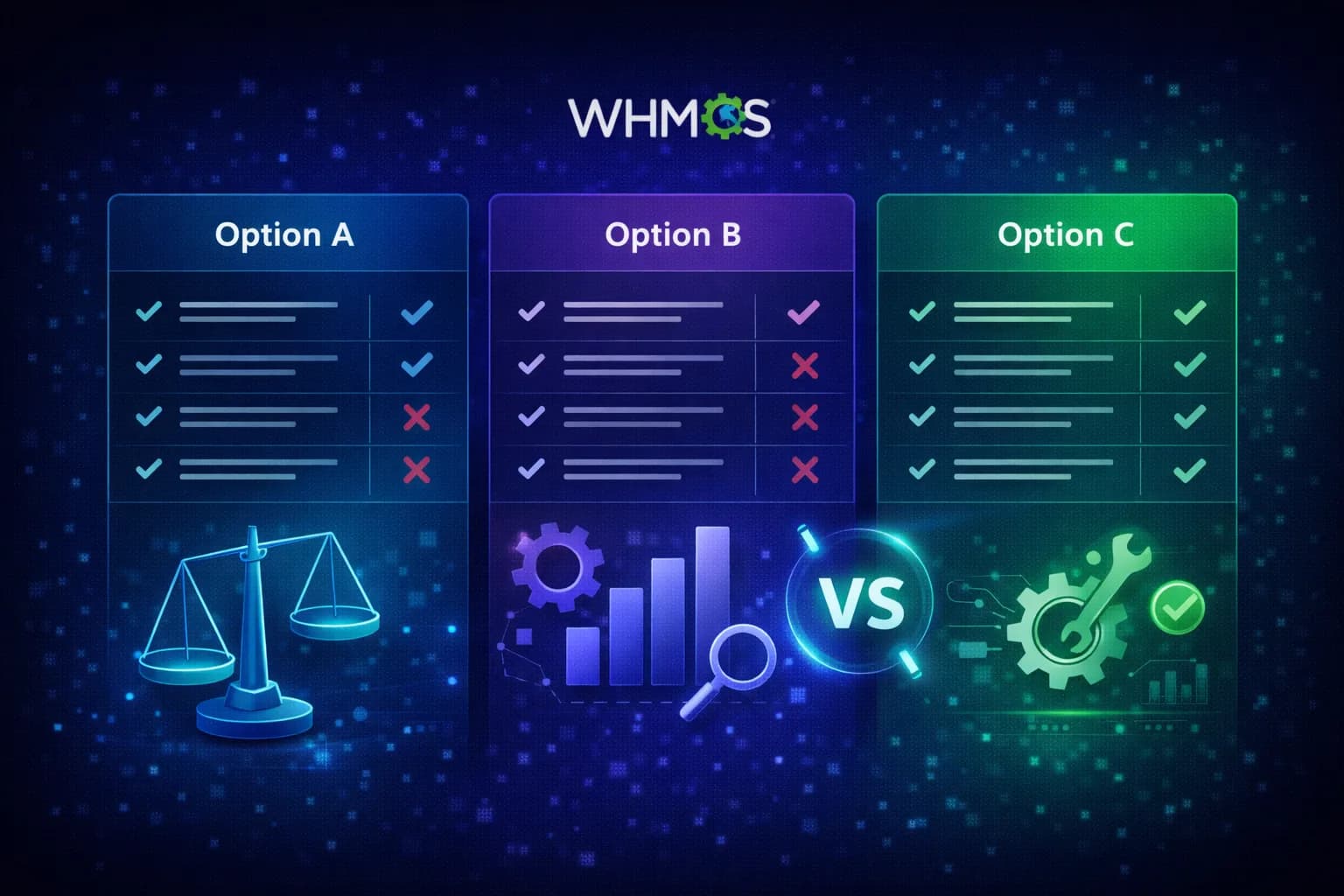
How Do They Compare?
| Feature | Standard API | MCP Server (AI) |
|---|---|---|
| Interface | Requires code/tools | Natural Language |
| Complexity | High (Endpoints/Auth) | Low (Conversational) |
| Speed | Slow (Manual lookup) | Instant (AI generated) |
| Flexibility | Static endpoints | Dynamic reasoning |
| Error Handling | Manual | AI-assisted |
| Authentication | Username/Secret | Token-based |
| Tool Management | Per-action | Global enable/disable |
| AI Integration | Requires wrapper | Native |
What is the Traditional WHMCS API?
How It Works
The WHMCS API exposes over 350 functions through HTTP POST requests:
<?php
$postfields = array(
    'identifier' => 'your_api_identifier',
    'secret' => 'your_api_secret',
    'action' => 'GetClients',
    'responsetype' => 'json',
);

$ch = curl_init();
curl_setopt($ch, CURLOPT_URL, 'https://your-whmcs.com/includes/api.php');
curl_setopt($ch, CURLOPT_POST, 1);
curl_setopt($ch, CURLOPT_POSTFIELDS, http_build_query($postfields));
curl_setopt($ch, CURLOPT_RETURNTRANSFER, 1);

$response = curl_exec($ch);
curl_close($ch);

$result = json_decode($response, true);
print_r($result);
Strengths
1. Complete Control
The API gives you access to nearly every WHMCS function. Many more than MCP exposes. Need to modify module settings or access hooks? The API can do it.
2. Automation Without Human Intervention
Build workflows that run 24/7 without any human interaction:
- Automatic provisioning
- Scheduled billing
- Batch operations
3. Complex Logic
Implement business logic that requires multiple API calls and conditional processing:
// Example: Suspend clients 30+ days overdue
$overdue = getOverdueInvoices(30);
foreach ($overdue as $invoice) {
    $services = getClientServices($invoice['userid']);
    foreach ($services as $service) {
        suspendService($service['id']);
    }
    sendNotification($invoice['userid']);
}
4. Third-Party Integration
Connect WHMCS to external systems:
- CRM synchronization
- Accounting software
- Custom client portals
What Are the Limitations?
1. You Need Coding Skills
Every task needs code. If you don't know how to program, you can't use the API.
2. Code Needs Maintenance
Your code can break when WHMCS updates. You also need to apply security patches.
3. No Natural Language
You can't ask questions. You can only run pre-built commands.
4. Steep Learning Curve
The API has 350+ functions. Learning them all takes time.
What is the MCP Server Approach?
For a complete step-by-step setup guide, see How to Integrate AI with WHMCS Using MCP.
How It Works
MCP provides a structured way for AI assistants to interact with WHMCS. Instead of code, you use natural language:
You: "Show me all clients who signed up this month"
Claude: Fetches data via MCP
Here are the 12 clients who signed up in January 2026:
- John Smith - Basic Hosting - $29/month
- ABC Company - Business Server - $199/month ...
Strengths
1. Zero Code Required
Anyone can interact with WHMCS data. No programming needed.
2. Natural Language Interface
Ask questions in plain English:
- "What's our revenue this week?"
- "Who has the most support tickets?"
- "Create an invoice for client 123"
3. Intelligent Responses
AI can interpret and summarize data:
You: "Are there any concerning trends in support tickets?"
Claude: Analyzes data
I notice that tickets related to email delivery increased 40% this month, primarily from clients using the Basic Hosting package. This might indicate a server configuration issue worth investigating.
4. Iterative Exploration
Build on previous queries:
You: "Show me clients with overdue invoices" Results shown You: "Of those, which have services still active?" Filtered results You: "Send them a payment reminder email"
What Are the Limitations?
1. Needs a Human
MCP needs a human to start each action. It can't run tasks at 3 AM on its own.
2. Limited Tools
MCP offers fewer tools than the full API. Some advanced features aren't included.
3. Needs AI Software
You need an AI app that supports MCP. Examples: Claude Desktop, Cursor.
4. Not for Bulk Tasks
MCP works at a chat pace. It's not ideal for tasks that need thousands of API calls.
When Should I Use Each?
Use the Traditional WHMCS API When
✅ Building automated workflows
- Scheduled tasks (daily reports, batch processing)
- Event-driven actions (webhook handlers)
- Continuous monitoring
✅ Integrating external systems
- CRM synchronization
- Accounting exports
- Custom client portals
✅ Processing high volumes
- Bulk invoice generation
- Mass client imports
- Large-scale provisioning
✅ Requiring advanced functions
- Module configuration
- Hook integration
- Custom field management
Use MCP Server When
✅ Exploring data interactively
- Ad-hoc queries and reports
- Investigating issues
- Business intelligence questions
✅ Helping non-technical staff
- Support team looking up client info
- Sales team creating quotes
- Management checking revenue
✅ AI-assisted operations
- Natural language WHMCS management
- Intelligent data analysis
- Contextual decision support
✅ Quick operations without coding
- One-off invoice creation
- Individual service management
- Client lookups
Can I Use Both Together?
Many businesses benefit from using both:
Scenario: Support Team Workflow
Daily automation (API):
- Generate morning reports
- Flag overdue accounts
- Send automatic reminders
Interactive queries (MCP):
- Support agent asks: "What services does client 456 have?"
- Manager asks: "Show me today's ticket volume by category"
- Sales asks: "Create a quote for enterprise hosting"
How to Set It Up
- Set up WHMCS API for background tasks
- Install MCP Server for AI queries
- Train your team on when to use each
The API handles bulk and repeated tasks. MCP handles questions and one-off actions.
How Does Security Compare?
| Security Aspect | WHMCS API | MCP Server |
|---|---|---|
| Authentication | Username + Secret | Token-based |
| Permissions | Admin or restricted | Configurable |
| Audit Logging | Via WHMCS logs | Built-in logging |
| IP Restrictions | Supported | Supported |
| Tool Management | Per-action | Global enable/disable |
Both approaches can be secured appropriately. The key difference:
- API: Credentials are stored in code/configuration
- MCP: Authentication happens per-session with the AI assistant
How Do I Decide Which to Use?
Choose API if
- You have developers on staff
- You need fully automated workflows
- You're integrating with other systems
- You need access to all WHMCS functions
Choose MCP Server if
- You want AI-powered WHMCS management
- Your team prefers natural language
- You need quick insights without coding
- You want human-in-the-loop control
See 10 WHMCS Tasks You Can Automate with AI for practical examples of what's possible.
Choose Both if
- You have varied use cases
- Different team members have different technical levels
- You want automation AND flexibility
How Do I Get Started?
For Traditional API
- Enable API access in WHMCS
- Generate API credentials
- Review the WHMCS API documentation
- Start with simple calls like
GetClients
For MCP Server
- Install MCP Server module
- Follow the setup documentation
- Configure with your AI assistant
- Start with read-only queries
- Progress to write operations
What's the Bottom Line?
The WHMCS API and MCP Server serve different purposes:
- API = Programmatic, automated, developer-focused
- MCP = Conversational, interactive, AI-focused
Neither is "better." They serve different needs. Many businesses use both: API for automation, MCP for AI chat.
AI is changing how we work. With MCP, you can ask "What happened with client ABC's invoice?" and get a quick answer. That's a big shift.
Ready to add AI to your WHMCS? Get MCP Server and start chatting with your data.
Still not sure which method is right for you? Contact our technical team for a personalized recommendation.
Frequently Asked Questions
Can I use both MCP and the WHMCS API at the same time?
Yes, and that's actually the recommended approach for many businesses. The two systems operate independently and don't conflict with each other. Use the traditional API for automated background tasks (scheduled reports, batch provisioning, webhook-triggered workflows). Use MCP for interactive queries and AI-assisted management (looking up clients, checking revenue, investigating issues). They complement each other well because they serve fundamentally different use cases.
Does MCP Server replace the WHMCS API?
No. MCP Server is an additional interface, not a replacement. The WHMCS API still covers more functions (350+), supports fully automated workflows, and handles bulk operations efficiently. MCP currently exposes a focused set of tools designed for conversational use. If you need to run a cron job that processes 500 invoices every night, that's an API task. If you want to ask "Which clients signed up this week and what did they order?" that's an MCP task.
Which option is better for custom integrations?
The traditional WHMCS API is better for custom integrations with external systems. If you're connecting WHMCS to a CRM, accounting software, or custom portal, you need the API's programmatic access and ability to run without human input. MCP is designed for human-to-AI interaction, not system-to-system communication. That said, if your "integration" is a support team member who needs quick access to client data during calls, MCP is faster to set up and easier to use than building a custom API tool.
Is MCP secure for production WHMCS installations?
Yes. MCP Server uses token-based authentication, supports IP restrictions, and includes built-in audit logging for every action. Permissions are configurable, so you can limit what the AI can read or modify. Sensitive operations require explicit confirmation before execution. Your data stays on your WHMCS server. The AI assistant queries it in real-time but doesn't store your client data. For additional security, you can use local AI models (via Ollama or similar) so no data leaves your network at all.
Do I need to be a developer to set up MCP Server?
No. Installing MCP Server follows the standard WHMCS module installation process: upload the files, activate the module, and configure your authentication token. Connecting it to Claude Desktop requires editing a JSON configuration file, which the setup guide walks through step by step. The entire setup takes 15-30 minutes. The traditional WHMCS API, by contrast, requires programming knowledge to do anything useful with it.
MCP Server
AI Integration for WHMCS
Connect AI to your WHMCS. Query clients, invoices, and tickets using natural language. Cancel anytime.
Documentation
Did you find this helpful?
Join other WHMCS professionals and get our latest guides and AI tips directly in your inbox.
MX Modules Team
We run a hosting business on WHMCS. These modules are the tools we built to solve our own problems, and now we share them with other providers.